Source Scope and Reconstructed Examples
The missing first-system setup and final six combinations have been reconstructed from the supplied tables. Missing explanatory passages have been completed with new text. The probability discussion has also been corrected, because catching ten numbers within a larger selection does not necessarily produce a winning ten-number combination.
Historical source examples: the quoted prizes, lottery comparisons, draw timing and operating conditions belong to the supplied account. They are not a statement of current rules for every Keno product. The reconstructed group arrangements and corrected probabilities are explained separately below.
How Grouped Keno Tickets Work
The source describes Keno Advanced as the Australian version of the way tickets played in the United States. Instead of marking each individual game separately, you assign letters to groups of numbers. The ticket then combines complete groups to create entries of your chosen size.
The author describes playing once or twice a month and choosing the ten-spot game for its potentially life-changing prize. The original example refers to a $1 million first prize plus jackpot money. That is a description of the source’s game, rather than a universal payout for every ten-spot product.
There are many ways to arrange an Advanced ticket. The important step is understanding which groups combine to make the required number of spots.
The examples below all create ten-number games. Their costs assume a $1 stake per combination for one draw, without a paid bonus option.
| Example | Numbers used | Ten-number combinations | Cost for one draw |
|---|---|---|---|
| Introductory example | 15 | 3 | $3 |
| System 1 | 15 | 9 | $9 |
| System 2 | 20 | 12 | $12 |
| System 3 | 25 | 16 | $16 |
| System 4 | 30 | 39 | $39 |
These arrangements buy more combinations. They do not improve the probability of an individual ten-number entry or guarantee a profit.
A Simple Example with Three Games
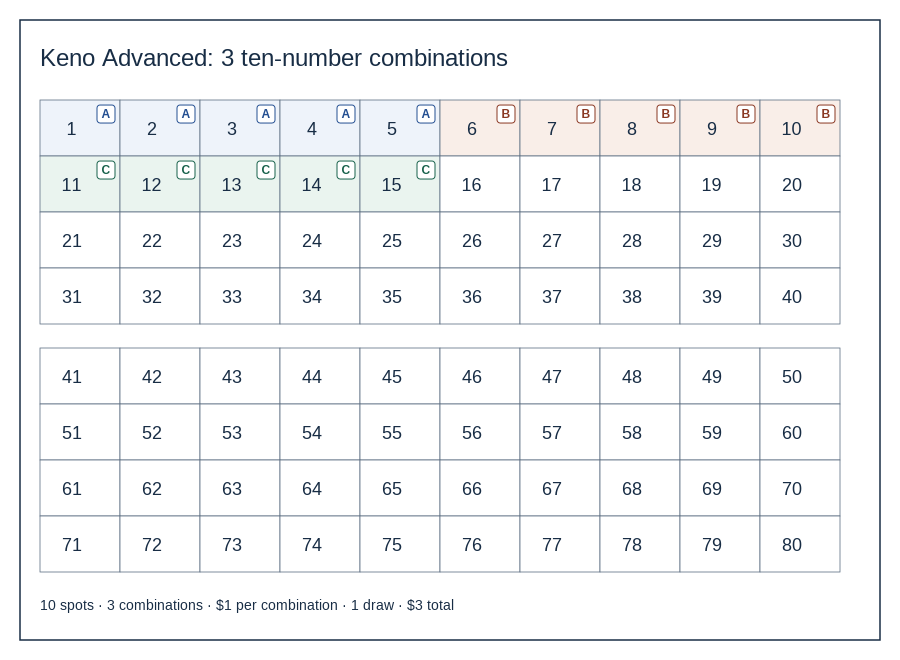
Start with 15 numbers. For illustration, use numbers 1 to 15 and divide them into three groups of five.
| Group | Numbers |
|---|---|
| A | 1, 2, 3, 4, 5 |
| B | 6, 7, 8, 9, 10 |
| C | 11, 12, 13, 14, 15 |
Number groups
- Group A1, 2, 3, 4, 5
- Group B6, 7, 8, 9, 10
- Group C11, 12, 13, 14, 15
One ten-number entry
A + B = 5 + 5 = 10 numbers
On the ticket, mark the first group with A, the second with B and the third with C.
Select the ten-spot option. Each pair of five-number groups produces one ten-number game.
| Game | Groups combined | Numbers |
|---|---|---|
| 1 | A + B | 1, 2, 3, 4, 5, 6, 7, 8, 9, 10 |
| 2 | A + C | 1, 2, 3, 4, 5, 11, 12, 13, 14, 15 |
| 3 | B + C | 6, 7, 8, 9, 10, 11, 12, 13, 14, 15 |
At $1 per combination, these three games cost $3 for one draw.
The source mentions lower stakes for some non-jackpot games and a $1 minimum for its jackpot example. Those conditions depend on the particular product. The calculations here consistently use $1 per combination.
System 1 with 15 Numbers and 9 Games
The first system’s setup is missing from the screenshots, but its nine individual entries show how the groups must be arranged.
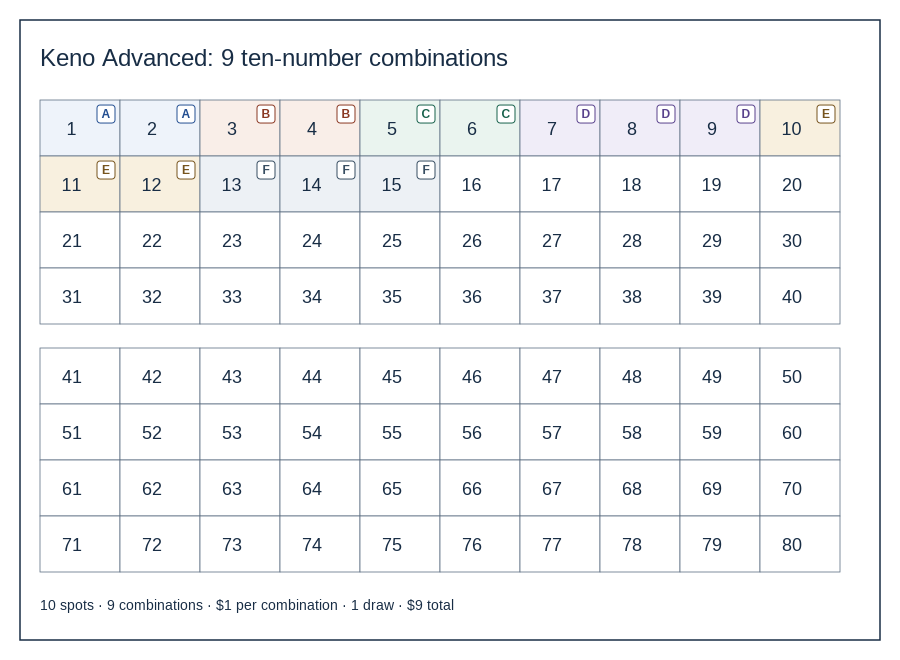
Divide numbers 1 to 15 into three groups of two and three groups of three.
| Group | Size | Numbers |
|---|---|---|
| A | 2 | 1, 2 |
| B | 2 | 3, 4 |
| C | 2 | 5, 6 |
| D | 3 | 7, 8, 9 |
| E | 3 | 10, 11, 12 |
| F | 3 | 13, 14, 15 |
Number groups
- Group A1, 2
- Group B3, 4
- Group C5, 6
- Group D7, 8, 9
- Group E10, 11, 12
- Group F13, 14, 15
One ten-number entry
A + B + D + E = 2 + 2 + 3 + 3 = 10 numbers
Each ten-number game combines two of the two-number groups and two of the three-number groups:
2 + 2 + 3 + 3 = 10.
There are three ways to choose the pair of two-number groups and three ways to choose the pair of three-number groups. This creates nine combinations.
All Nine Individual Games
| Ticket | Groups | Numbers |
|---|---|---|
| 1 | A + B + D + E | 1, 2, 3, 4, 7, 8, 9, 10, 11, 12 |
| 2 | A + B + D + F | 1, 2, 3, 4, 7, 8, 9, 13, 14, 15 |
| 3 | A + B + E + F | 1, 2, 3, 4, 10, 11, 12, 13, 14, 15 |
| 4 | A + C + D + E | 1, 2, 5, 6, 7, 8, 9, 10, 11, 12 |
| 5 | A + C + D + F | 1, 2, 5, 6, 7, 8, 9, 13, 14, 15 |
| 6 | A + C + E + F | 1, 2, 5, 6, 10, 11, 12, 13, 14, 15 |
| 7 | B + C + D + E | 3, 4, 5, 6, 7, 8, 9, 10, 11, 12 |
| 8 | B + C + D + F | 3, 4, 5, 6, 7, 8, 9, 13, 14, 15 |
| 9 | B + C + E + F | 3, 4, 5, 6, 10, 11, 12, 13, 14, 15 |
The cost is $9 for one draw at $1 per combination.
How Matches Can Appear on Several Games
Some smaller sets of numbers appear in several entries.
For example, 1, 2, 7 and 8 appear together on tickets 1, 2, 4 and 5. If those four numbers are drawn, each of those entries has at least four matches.
The source describes a $4 return from this example. That requires a paytable paying $1 for four matches on a $1 ten-spot entry, with exactly four matches on each relevant entry. Additional matches can change the payout.
The overlapping entries can produce several prizes from the same draw, but the total returned may still be less than the $9 ticket cost.
System 2 with 20 Numbers and 12 Games
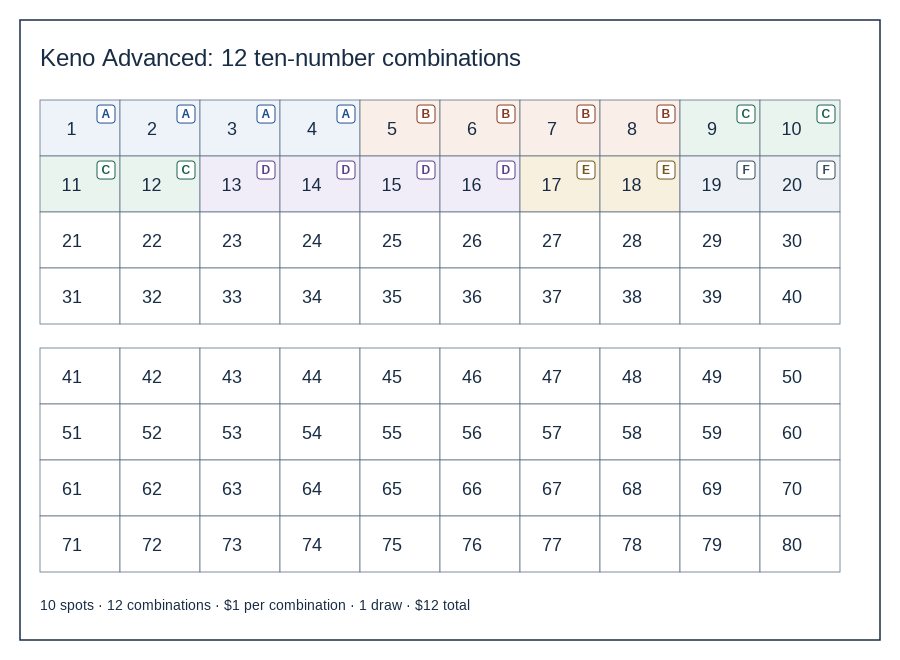
Divide numbers 1 to 20 into four groups of four and two groups of two.
| Group | Size | Numbers |
|---|---|---|
| A | 4 | 1, 2, 3, 4 |
| B | 4 | 5, 6, 7, 8 |
| C | 4 | 9, 10, 11, 12 |
| D | 4 | 13, 14, 15, 16 |
| E | 2 | 17, 18 |
| F | 2 | 19, 20 |
Number groups
- Group A1, 2, 3, 4
- Group B5, 6, 7, 8
- Group C9, 10, 11, 12
- Group D13, 14, 15, 16
- Group E17, 18
- Group F19, 20
One ten-number entry
A + B + E = 4 + 4 + 2 = 10 numbers
Each game combines two four-number groups and one two-number group:
4 + 4 + 2 = 10.
There are six possible pairs of four-number groups. Combining each pair with E or F creates 12 games.
All 12 Individual Games
| Ticket | Groups | Numbers |
|---|---|---|
| 1 | A + B + E | 1, 2, 3, 4, 5, 6, 7, 8, 17, 18 |
| 2 | A + B + F | 1, 2, 3, 4, 5, 6, 7, 8, 19, 20 |
| 3 | A + C + E | 1, 2, 3, 4, 9, 10, 11, 12, 17, 18 |
| 4 | A + C + F | 1, 2, 3, 4, 9, 10, 11, 12, 19, 20 |
| 5 | A + D + E | 1, 2, 3, 4, 13, 14, 15, 16, 17, 18 |
| 6 | A + D + F | 1, 2, 3, 4, 13, 14, 15, 16, 19, 20 |
| 7 | B + C + E | 5, 6, 7, 8, 9, 10, 11, 12, 17, 18 |
| 8 | B + C + F | 5, 6, 7, 8, 9, 10, 11, 12, 19, 20 |
| 9 | B + D + E | 5, 6, 7, 8, 13, 14, 15, 16, 17, 18 |
| 10 | B + D + F | 5, 6, 7, 8, 13, 14, 15, 16, 19, 20 |
| 11 | C + D + E | 9, 10, 11, 12, 13, 14, 15, 16, 17, 18 |
| 12 | C + D + F | 9, 10, 11, 12, 13, 14, 15, 16, 19, 20 |
The cost is $12 for one draw at $1 per combination.
System 3 with 25 Numbers and 16 Games
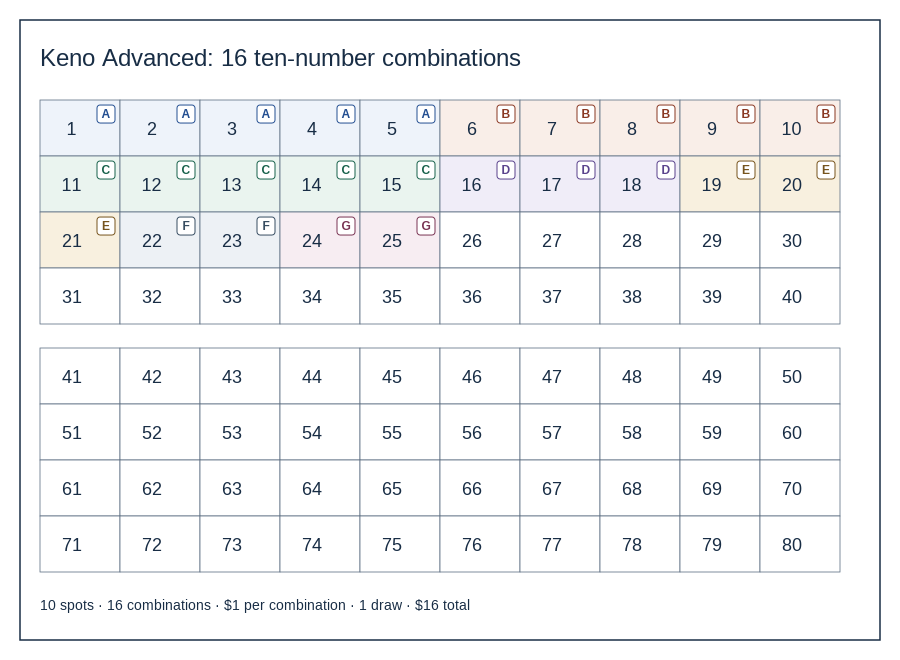
Divide numbers 1 to 25 into three groups of five, two groups of three and two groups of two.
| Group | Size | Numbers |
|---|---|---|
| A | 5 | 1, 2, 3, 4, 5 |
| B | 5 | 6, 7, 8, 9, 10 |
| C | 5 | 11, 12, 13, 14, 15 |
| D | 3 | 16, 17, 18 |
| E | 3 | 19, 20, 21 |
| F | 2 | 22, 23 |
| G | 2 | 24, 25 |
Number groups
- Group A1, 2, 3, 4, 5
- Group B6, 7, 8, 9, 10
- Group C11, 12, 13, 14, 15
- Group D16, 17, 18
- Group E19, 20, 21
- Group F22, 23
- Group G24, 25
One ten-number entry
A + D + F = 5 + 3 + 2 = 10 numbers
This arrangement creates ten-number games in three different ways.
| Group sizes combined | Number of games |
|---|---|
| 5 + 5 | 3 |
| 5 + 3 + 2 | 12 |
| 3 + 3 + 2 + 2 | 1 |
| Total | 16 |
All 16 Individual Games
| Ticket | Groups | Numbers |
|---|---|---|
| 1 | A + B | 1, 2, 3, 4, 5, 6, 7, 8, 9, 10 |
| 2 | A + C | 1, 2, 3, 4, 5, 11, 12, 13, 14, 15 |
| 3 | B + C | 6, 7, 8, 9, 10, 11, 12, 13, 14, 15 |
| 4 | A + D + F | 1, 2, 3, 4, 5, 16, 17, 18, 22, 23 |
| 5 | A + D + G | 1, 2, 3, 4, 5, 16, 17, 18, 24, 25 |
| 6 | A + E + F | 1, 2, 3, 4, 5, 19, 20, 21, 22, 23 |
| 7 | A + E + G | 1, 2, 3, 4, 5, 19, 20, 21, 24, 25 |
| 8 | B + D + F | 6, 7, 8, 9, 10, 16, 17, 18, 22, 23 |
| 9 | B + D + G | 6, 7, 8, 9, 10, 16, 17, 18, 24, 25 |
| 10 | B + E + F | 6, 7, 8, 9, 10, 19, 20, 21, 22, 23 |
| 11 | B + E + G | 6, 7, 8, 9, 10, 19, 20, 21, 24, 25 |
| 12 | C + D + F | 11, 12, 13, 14, 15, 16, 17, 18, 22, 23 |
| 13 | C + D + G | 11, 12, 13, 14, 15, 16, 17, 18, 24, 25 |
| 14 | C + E + F | 11, 12, 13, 14, 15, 19, 20, 21, 22, 23 |
| 15 | C + E + G | 11, 12, 13, 14, 15, 19, 20, 21, 24, 25 |
| 16 | D + E + F + G | 16, 17, 18, 19, 20, 21, 22, 23, 24, 25 |
The cost is $16 for one draw at $1 per combination.
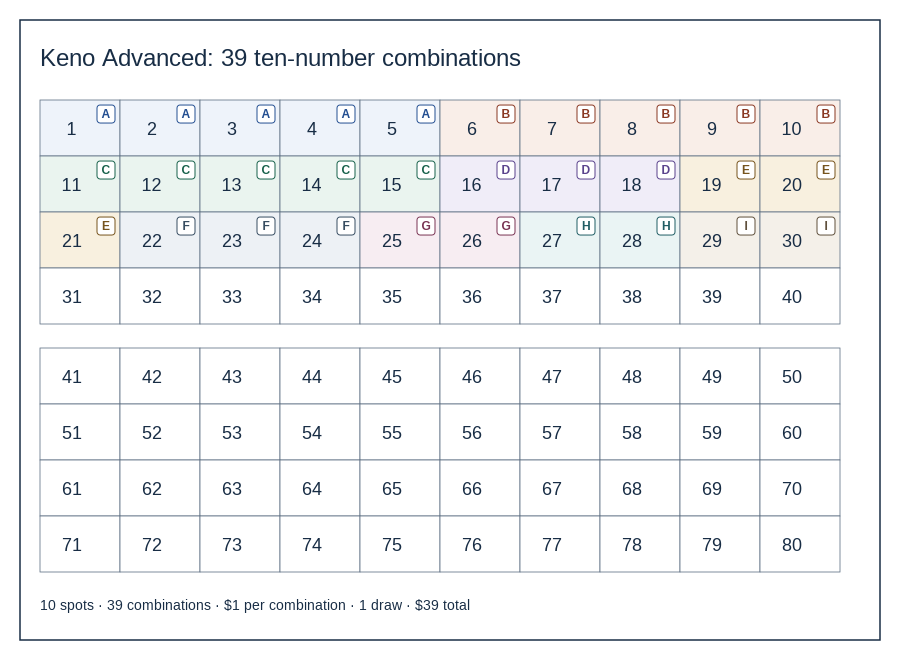
System 4 with 30 Numbers and 39 Games
Divide numbers 1 to 30 into three groups of five, three groups of three and three groups of two.
| Group | Size | Numbers |
|---|---|---|
| A | 5 | 1, 2, 3, 4, 5 |
| B | 5 | 6, 7, 8, 9, 10 |
| C | 5 | 11, 12, 13, 14, 15 |
| D | 3 | 16, 17, 18 |
| E | 3 | 19, 20, 21 |
| F | 3 | 22, 23, 24 |
| G | 2 | 25, 26 |
| H | 2 | 27, 28 |
| I | 2 | 29, 30 |
Number groups
- Group A1, 2, 3, 4, 5
- Group B6, 7, 8, 9, 10
- Group C11, 12, 13, 14, 15
- Group D16, 17, 18
- Group E19, 20, 21
- Group F22, 23, 24
- Group G25, 26
- Group H27, 28
- Group I29, 30
One ten-number entry
D + F + G + H = 3 + 3 + 2 + 2 = 10 numbers
The complete combination count is:
| Group sizes combined | Number of games |
|---|---|
| 5 + 5 | 3 |
| 5 + 3 + 2 | 27 |
| 3 + 3 + 2 + 2 | 9 |
| Total | 39 |
All 39 Individual Games
Tickets 34–39 complete the portion missing from the supplied screenshots.
| Ticket | Groups | Numbers |
|---|---|---|
| 1 | A + B | 1, 2, 3, 4, 5, 6, 7, 8, 9, 10 |
| 2 | A + C | 1, 2, 3, 4, 5, 11, 12, 13, 14, 15 |
| 3 | B + C | 6, 7, 8, 9, 10, 11, 12, 13, 14, 15 |
| 4 | A + D + G | 1, 2, 3, 4, 5, 16, 17, 18, 25, 26 |
| 5 | A + D + H | 1, 2, 3, 4, 5, 16, 17, 18, 27, 28 |
| 6 | A + D + I | 1, 2, 3, 4, 5, 16, 17, 18, 29, 30 |
| 7 | A + E + G | 1, 2, 3, 4, 5, 19, 20, 21, 25, 26 |
| 8 | A + E + H | 1, 2, 3, 4, 5, 19, 20, 21, 27, 28 |
| 9 | A + E + I | 1, 2, 3, 4, 5, 19, 20, 21, 29, 30 |
| 10 | A + F + G | 1, 2, 3, 4, 5, 22, 23, 24, 25, 26 |
| 11 | A + F + H | 1, 2, 3, 4, 5, 22, 23, 24, 27, 28 |
| 12 | A + F + I | 1, 2, 3, 4, 5, 22, 23, 24, 29, 30 |
| 13 | B + D + G | 6, 7, 8, 9, 10, 16, 17, 18, 25, 26 |
| 14 | B + D + H | 6, 7, 8, 9, 10, 16, 17, 18, 27, 28 |
| 15 | B + D + I | 6, 7, 8, 9, 10, 16, 17, 18, 29, 30 |
| 16 | B + E + G | 6, 7, 8, 9, 10, 19, 20, 21, 25, 26 |
| 17 | B + E + H | 6, 7, 8, 9, 10, 19, 20, 21, 27, 28 |
| 18 | B + E + I | 6, 7, 8, 9, 10, 19, 20, 21, 29, 30 |
| 19 | B + F + G | 6, 7, 8, 9, 10, 22, 23, 24, 25, 26 |
| 20 | B + F + H | 6, 7, 8, 9, 10, 22, 23, 24, 27, 28 |
| 21 | B + F + I | 6, 7, 8, 9, 10, 22, 23, 24, 29, 30 |
| 22 | C + D + G | 11, 12, 13, 14, 15, 16, 17, 18, 25, 26 |
| 23 | C + D + H | 11, 12, 13, 14, 15, 16, 17, 18, 27, 28 |
| 24 | C + D + I | 11, 12, 13, 14, 15, 16, 17, 18, 29, 30 |
| 25 | C + E + G | 11, 12, 13, 14, 15, 19, 20, 21, 25, 26 |
| 26 | C + E + H | 11, 12, 13, 14, 15, 19, 20, 21, 27, 28 |
| 27 | C + E + I | 11, 12, 13, 14, 15, 19, 20, 21, 29, 30 |
| 28 | C + F + G | 11, 12, 13, 14, 15, 22, 23, 24, 25, 26 |
| 29 | C + F + H | 11, 12, 13, 14, 15, 22, 23, 24, 27, 28 |
| 30 | C + F + I | 11, 12, 13, 14, 15, 22, 23, 24, 29, 30 |
| 31 | D + E + G + H | 16, 17, 18, 19, 20, 21, 25, 26, 27, 28 |
| 32 | D + E + G + I | 16, 17, 18, 19, 20, 21, 25, 26, 29, 30 |
| 33 | D + E + H + I | 16, 17, 18, 19, 20, 21, 27, 28, 29, 30 |
| 34 | D + F + G + H | 16, 17, 18, 22, 23, 24, 25, 26, 27, 28 |
| 35 | D + F + G + I | 16, 17, 18, 22, 23, 24, 25, 26, 29, 30 |
| 36 | D + F + H + I | 16, 17, 18, 22, 23, 24, 27, 28, 29, 30 |
| 37 | E + F + G + H | 19, 20, 21, 22, 23, 24, 25, 26, 27, 28 |
| 38 | E + F + G + I | 19, 20, 21, 22, 23, 24, 25, 26, 29, 30 |
| 39 | E + F + H + I | 19, 20, 21, 22, 23, 24, 27, 28, 29, 30 |
The cost is $39 for one draw at $1 per combination.
Catching Ten Numbers Is Different from Winning a Ten-Spot Game
Selecting a larger pool makes it more likely that ten or more of the drawn numbers fall somewhere within that pool.
However, the ten matched numbers must appear together in one of the combinations actually purchased to produce a ten-spot top-prize result.
For example, the 30-number system contains 39 entries. There are 30,045,015 possible ten-number subsets within 30 numbers. The system plays only the 39 combinations listed above.
Ten numbers can therefore appear within your 30-number pool without completing any of your ten-spot entries.
Corrected Probabilities for Larger Number Pools
For a fair draw of 20 different numbers from 80, the following figures describe the chance of catching at least ten numbers anywhere within a fixed pool.
They are not jackpot probabilities for the grouped systems.
| Numbers in the pool | Chance of catching at least ten | Approximately |
|---|---|---|
| 15 | 0.01651% | 1 in 6,058 |
| 20 | 0.47426% | 1 in 211 |
| 25 | 3.71896% | 1 in 26.89 |
| 30 | 14.32884% | 1 in 6.98 |
These figures were calculated using the hypergeometric distribution, which accounts for drawing without replacement.
The source’s suggestion that ten numbers within a 30-number pool might be expected in every draw is incorrect. Even with 30 numbers selected, fewer than ten matches occur in about 85.67% of draws.
A particular ten-number entry has a top-match probability of approximately 1 in 8.91 million. Official Keno information gives the ten-number jackpot odds as approximately 1 in 8,911,711.
Reference: Office of Responsible Gambling: Info about the odds (November 2024)
How Multiple Smaller Prizes Can Occur
The entries overlap, so one drawn number can contribute to matches on several purchased games.
Eight or more matches within the overall number pool may produce several smaller prizes. Fewer than eight may also produce prizes, depending on how the matches are distributed and which paytable applies.
The source gives an example involving eight matches within 25 selected numbers. For exactly eight matches, the calculated probability is approximately 13.42%, or 1 in 7.45. This replaces the source’s unclear “0.213 to 1” figure.
Even when eight numbers match somewhere in the pool, those eight may not all appear together on a purchased entry.
There is also a distinction between mathematical subsets and paid entries:
| Drawn numbers within your pool | Possible ten-number subsets |
|---|---|
| 10 | 1 |
| 11 | 11 |
| 12 | 66 |
The source correctly states that 11 numbers contain 11 ten-number subsets and 12 numbers contain 66. However, only subsets matching purchased entries can produce ten-spot prizes.
Comparing the Source’s Keno and Lottery Figures
The original text compares ten-spot Keno with Lotto, Oz Lotto and Powerball. Its figures are reproduced below as historical source data.
| Game | First-prize odds quoted in the source | Prize divisions quoted |
|---|---|---|
| Keno | 1 in 8,911,711 | 7 |
| Lotto | 1 in 8,145,060 | 6 |
| Oz Lotto | 1 in 45,379,620 | 7 |
| Powerball | 1 in 76,767,600 | 8 |
These are the figures used by the original author, not a current comparison of every named game.
The author’s argument is that the quoted Keno and Lotto first-prize odds are relatively close, while the quoted Oz Lotto and Powerball odds are longer.
The source also describes Keno as running every day, with one draw every three minutes and 20 numbers drawn. More frequent draws offer more opportunities to purchase entries, but they do not improve the probability of any single entry.
Checking the Systems Against Draw Results
You can check the tables against a complete draw containing 20 distinct numbers from 1 to 80.
For each listed entry:
Count how many of its ten numbers appear in the draw.
Find the applicable prize in the game’s paytable.
Record the return for that entry.
Add the returns from all purchased entries.
Subtract the total ticket cost to calculate the net result.
The source suggests examining a fixed pool such as numbers 51 to 80 over 100, 200 or more draws. This can illustrate variation, but a short run of results does not establish the true probability or show that a number is due.
Draws can produce long gaps without ten matches in a pool, followed by a draw with 11 or 12. The variation does not change the probability of the next independent draw.
The source also raises the possibility of computer-generated bias without supplying evidence. A run of unusual results alone does not demonstrate bias or provide a dependable selection method.
Sharing a System Through a Syndicate
The original text suggests sharing the cost in a syndicate, as players sometimes do with lottery games.
For the $16 system, two simple arrangements are:
| Members | Contribution per member | Total stake | Equal share per member |
|---|---|---|---|
| 4 | $4 | $16 | 25% |
| 8 | $2 | $16 | 12.5% |
These contributions cover one draw at $1 per combination.
Agree in advance how often the syndicate will play, which system it will use and how prizes will be divided. Weekly, monthly or occasional play will create different total costs.
After buying the ticket, photograph the receipt and share it with the members before the draw. Keep a record of contributions, entries and returns so everyone can see what was purchased.
Unequal contributions require an agreed share arrangement rather than an assumption that every member receives the same amount.
Choosing Numbers and Managing the Cost
Numbers 1 to 15, 1 to 20 and the other consecutive ranges are used to make the examples easy to follow. You can replace them with other distinct numbers while keeping the group sizes unchanged.
The source advises avoiding obvious sequences because other players may choose them. A different selection does not improve the chance of being drawn. It may affect prize sharing only where the game’s rules divide a prize among winners.
Check the relevant product’s rules for stakes, prize schedules and jackpot sharing. The source directs readers to keno.com.au for information.
Reference: Keno: product information and game rules
A larger system costs more and can still return nothing or less than its purchase price. Even when several entries win smaller prizes, the combined return may not cover the ticket.
The source closes by acknowledging that players will probably lose money on most draws. A grouped ticket provides a convenient way to organise several bets, but it does not remove that risk.