What Is a King Ticket?
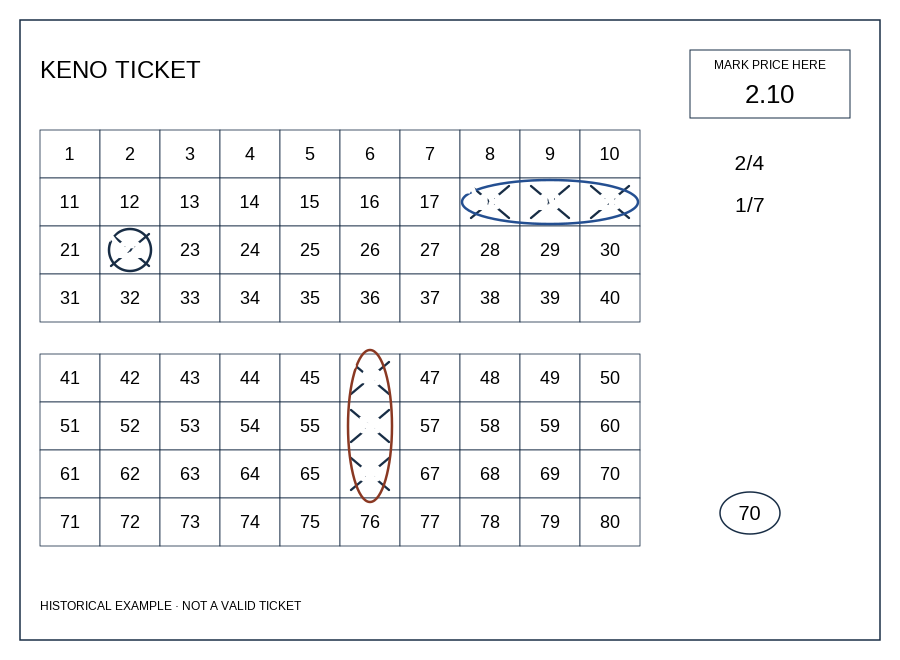
A king ticket may be defined as any ticket in which there appears a single circled number. This single number is the king, and is not played alone, but is combined with other numbers to form various ways. Let’s look at a sample king ticket.
| Way | Selected numbers | Spots | Stake |
|---|---|---|---|
| King + A | 18, 19, 20, 22 | 4 | $0.70 |
| King + B | 22, 46, 56, 66 | 4 | $0.70 |
| King + A + B | 18, 19, 20, 22, 46, 56, 66 | 7 | $0.70 |
| Total | Three ways | $2.10 |
Combining One King with Two Three-Spot Groups
In the above ticket, the number “22” was king, and was used in combination with each three-spot separately to form two four-spots, and then in combination with both three-spots to form one seven-spot. This is a fairly simple king ticket. The next one is a bit more complicated.
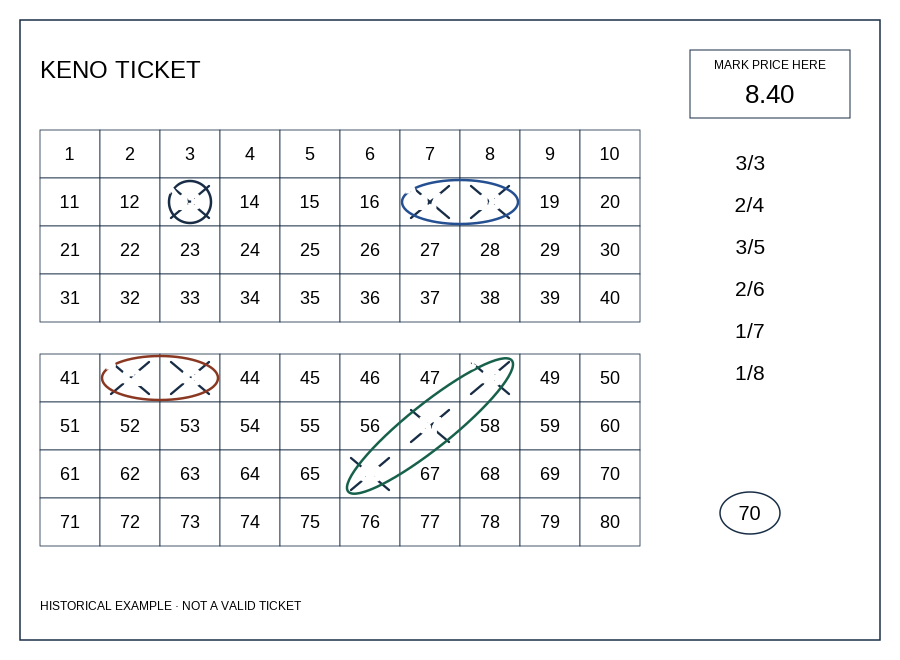
| Ticket notation | Number of ways | Spots per way |
|---|---|---|
| 3/3 | 3 | 3 |
| 2/4 | 2 | 4 |
| 3/5 | 3 | 5 |
| 2/6 | 2 | 6 |
| 1/7 | 1 | 7 |
| 1/8 | 1 | 8 |
| Total | 12 |
The illustrated ticket has king number 13, Group A of 17 and 18, Group B of 42 and 43, and Group C of 48, 57 and 66. The printed notation totals twelve ways at $0.70 per way, for $8.40. It is retained as supplied; the twelve-way notation has not been independently derived from the group explanation.
Calculating the Cost of a Twelve-Way Ticket
In the above example, we were able to make twelve different ways out of one ticket. Even at 70¢ a way, the tickets cost $8.40. So again, we see that these keno tickets can become expensive.
Tickets with More Than One King
King tickets may have more than one king, and there are all king tickets that can be written. But they should be carefully studied, because of their complex nature. And always consult with a keno writer when you’re not sure of how to write the ticket, or not sure if you’ve gotten a payoff. They’ll be happy to help, and don’t forget to toke them for their aid.
Reading All Twelve Paid Combinations
The twelve-way illustration gives group sizes and notation, but the supplied text does not list every paid entry. The table below is a reconstruction consistent with those markings: 3 three-spots, 2 four-spots, 3 five-spots, 2 six-spots, 1 seven-spot and 1 eight-spot. K means the king number 13. A, B and C are the groups shown on the ticket.
| Groups used | Selected numbers | Spots | Stake |
|---|---|---|---|
| C | 48, 57, 66 | 3 | $0.70 |
| K + A | 13, 17, 18 | 3 | $0.70 |
| K + B | 13, 42, 43 | 3 | $0.70 |
| A + B | 17, 18, 42, 43 | 4 | $0.70 |
| K + C | 13, 48, 57, 66 | 4 | $0.70 |
| A + C | 17, 18, 48, 57, 66 | 5 | $0.70 |
| B + C | 42, 43, 48, 57, 66 | 5 | $0.70 |
| K + A + B | 13, 17, 18, 42, 43 | 5 | $0.70 |
| K + A + C | 13, 17, 18, 48, 57, 66 | 6 | $0.70 |
| K + B + C | 13, 42, 43, 48, 57, 66 | 6 | $0.70 |
| A + B + C | 17, 18, 42, 43, 48, 57, 66 | 7 | $0.70 |
| K + A + B + C | 13, 17, 18, 42, 43, 48, 57, 66 | 8 | $0.70 |
| Total | Twelve paid entries | $8.40 |
This interpretation includes C alone and some combinations without K. It therefore does not mean “the king must appear in every paid entry.” The historical opening definition describes the king’s role, not a complete list of this ticket’s bets. The grouping labels identify selections; they do not add drawn numbers or establish that any entry wins. Confirm the exact paid combinations with the operator before buying a conditioned ticket.