Checking Your Results with a Punch-Out Ticket
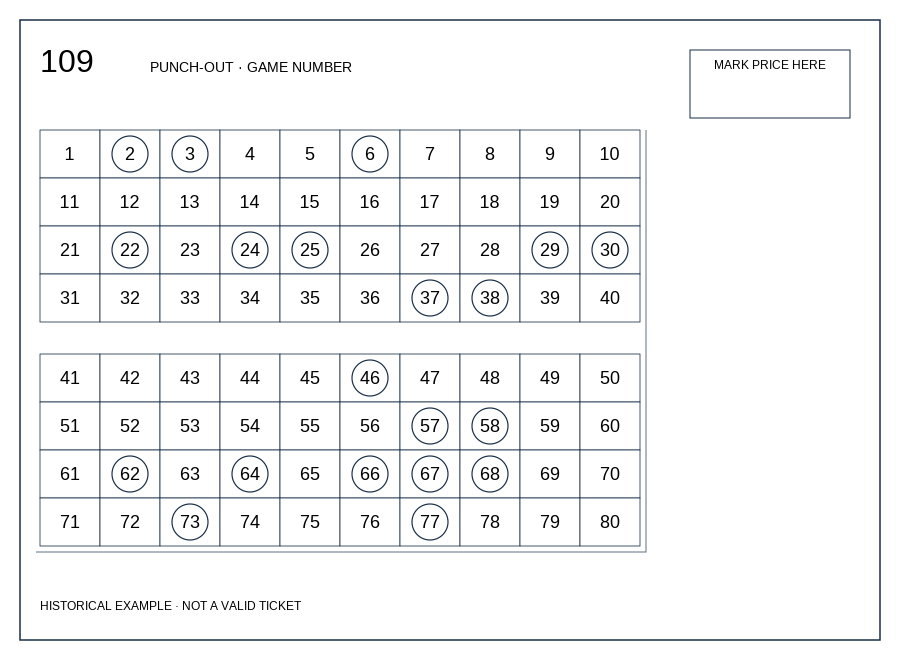
If in doubt about whether or not you’ve won, you can request the punch-out ticket and place your ticket under it. The following is a punch-out ticket from a Strip hotel in Las Vegas.
Replaying the Same Numbers
Many players have favorite numbers they bet on to the exclusion of other numbers. They may select a group of numbers and keep playing those same numbers all day long. If that’s the case, it’s not necessary to keep writing new tickets.
When you wish to replay a ticket, you simply hand in the duplicate ticket you’ve been issued by the keno writer, and this now becomes the original, and you’re given a new duplicate. You can do this indefinitely, until you get tired of the numbers, or you finally hit it big.
Ten Steps for Completing and Playing a Keno Ticket
Chart 5. Keno Ticket Checklist
Take a keno blank, whether in the keno lounge or in any area of the casino where keno runners are available, and X out the numbers you wish to play with the crayon that the casino offers.
After you’ve Xed out the numbers, add them up. There must be at least 1 and no more than 15 numbers selected. Place this number of spots selected in the right hand margin of the ticket.
Then choose the amount you want to bet, checking the rate card first to see the possible payoffs. After you’ve decided this, put that price without using either a dollar sign ($) or a cents sign (c) in the box in the upper right hand corner of the blank ticket.
Take the ticket up to the keno writer or give it to a keno runner. The keno writer will give you back a duplicate, as will the keno runner, after you pay the money necessary to play the ticket.
Verify that your ticket is marked correctly. When there’s a dispute, the original ticket, the one you marked, predominates.
Watch the board to see if you’ve caught enough numbers for a payoff. If you have, then go up immediately, before the next game is called, and collect your payoff.
If you use a keno runner, have her collect for you by giving her the ticket and telling her there’s money to be collected. She’ll do it for you. It is customary to toke the runner in this event, or the keno writer if you’ve collected a substantial amount.
If in doubt about winning, either check the punch-out ticket, or have the keno writer do it for you. He’ll be happy to accommodate you.
You’re not limited to playing one ticket. You can play several if you want, at one time, as long as you follow the procedure of marking them correctly.
You can replay your ticket, by either giving the duplicate to the keno writer, or handing it to the keno runner and stating that you wish to replay the ticket.
Don’t fold or mutilate your ticket or mark it in any way. It’s a very valuable commodity, especially if you catch some winning numbers.
How Straight Keno Tickets Work
In our discussion concerning the writing of keno tickets, we showed how a straight ticket should be written and bet upon. A straight ticket is the most common kind of ticket, which can be marked up from 1 to 15 numbers and played for either the minimum amount, usually 70¢ in downtown Las Vegas, Reno and Lake Tahoe, or for $1 or $2 minimum in the fancier Strip hotels.
Choosing a Stake for a Straight Ticket
When playing straight tickets, you can play either for the minimum for multiples of the minimum. However, if you’re aiming to win $50,000, you don’t have to bet too much over the minimum. For example, if you’re playing a 12-spot (12 numbers), a $1.40 bet entitles you to $50,000 if you hit all the numbers. And when playing 13, 14 and 15 spot tickets, the same bet will get you $50,000.
However, with an 8-9-10 or 11 spot, you’d have to bet $3.50 to win $50,000, and the amount bet increases dramatically when playing smaller spot tickets. If you play a 6-spot, for example, it would take about $32.20 to win the $50,000.
Most beginning players, and even experienced players, prefer the straight tickets. They’re simple to play, and the payoffs are simple to calculate. However, these aren’t the only tickets that can be written, and some others offer a variety of payoffs and possibilities, making keno even more interesting to play.
How Split Keno Tickets Work
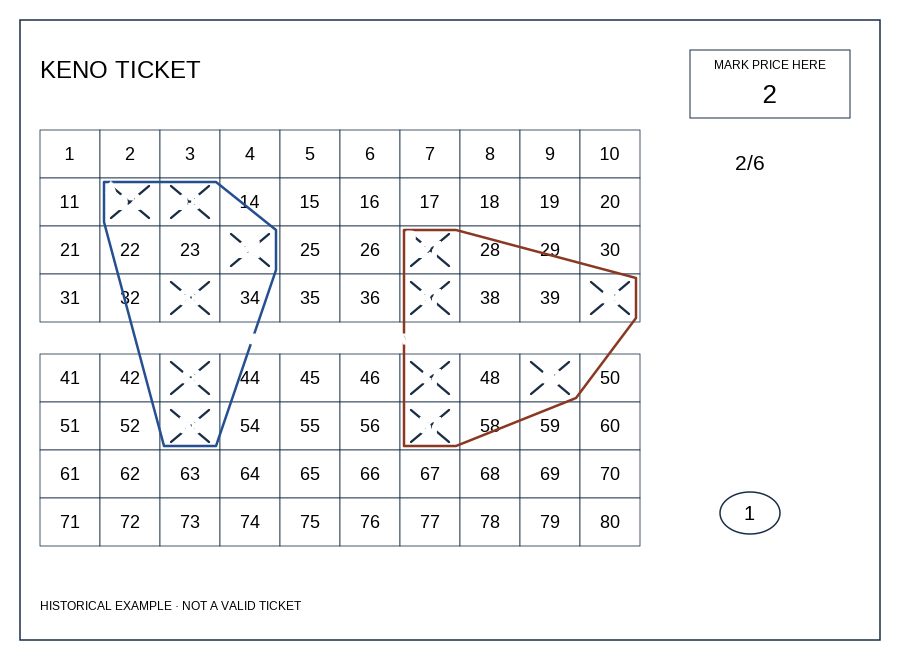
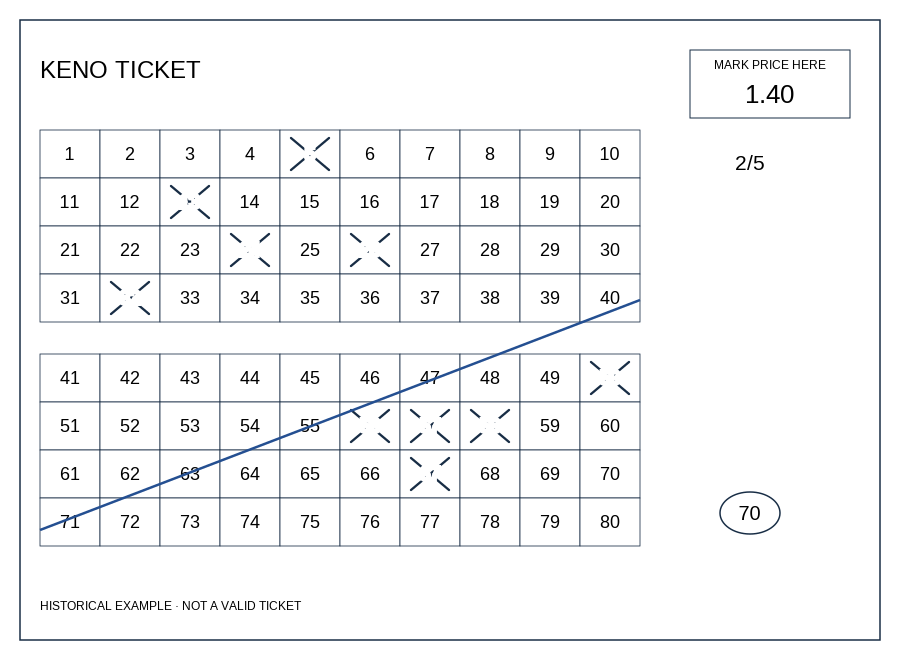
A split ticket allows a player to write two or more tickets in one, splitting the numbers by either circling them or drawing a line between them. When writing a split ticket, the player is limited in that the numbers in one group can’t be duplicated in the other group. They must be kept separate. But a player may mark 1 to 15 numbers in each group. The following are two split tickets, one separated by circling one group, and the other by drawing a line.
Dividing a Ticket into More Than Two Groups
Before we examine these tickets, remember that you’re not limited to two games at one time. If you want to, you can split the ticket three or more ways, as long as there are sufficient numbers that can’t be duplicated. For example, if you played two-spots you could split the ticket 40 ways, but this kind of splitting isn’t recommended.
Reduced Stakes on Split Tickets
One final note. Some casinos will allow a player to bet on split tickets at a reduced rate, usually half of the minimum. Thus, if a player split a ticket into four tickets, where the minimum was $1, he could play for $2, each split ticket worth 50¢. However, if he catches good, then the payoff will be one-half of what the rate card shows for $1.
Marking Two Six-Spot Groups with Circles
The above split ticket is made up of two 6-spots, each played for $1. The player should mark the total price in the upper right hand box, then mark 2/6 to show that two separate six-spot straight tickets are being played as a split ticket. Then he should circle at the bottom margin the price for each individual split ticket.
To be doubly safe, inform the keno writer that this is a split ticket.
Separating Two Five-Spot Groups with a Line
The next split ticket is of 5-spots, the two parts separated by a line.
Counting Winning Numbers Within Each Group
When playing a split ticket, it’s important to remember that each split part is played as a separate ticket, so, if you play two six-spots and need to catch three numbers for a payoff, you’ll have to catch those three on one of the split parts. You can’t take two numbers from one part and one from the other for a payoff.
Combining Groups with Different Numbers of Spots
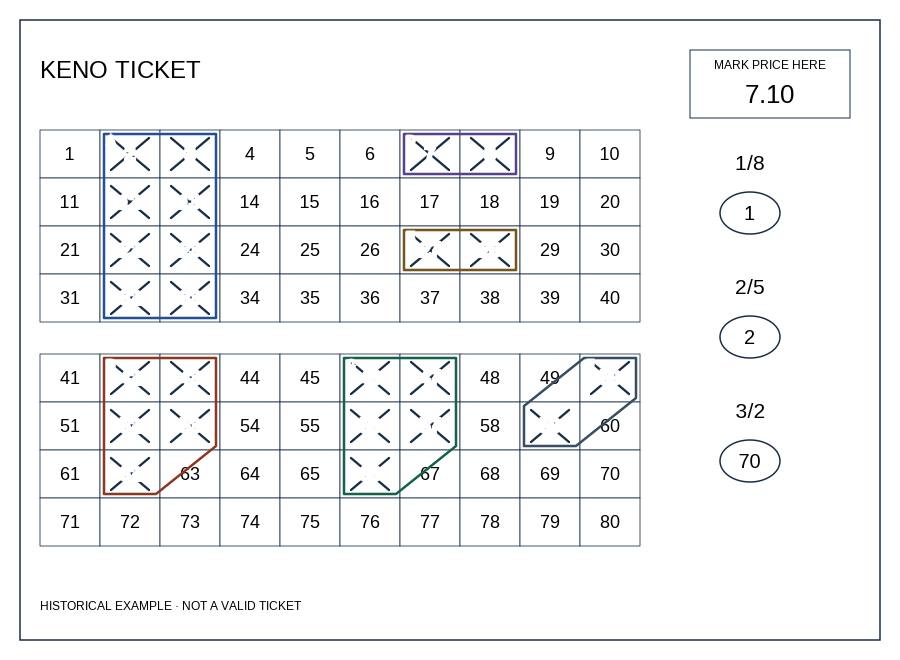
When playing split tickets, you don’t have to have equal groups. You might divide the ticket, that is, split it, so that you’re playing two 5-spots, one eight-spot and three two-spots, for example. On the margin you’d write 1/8, 2/5 and 3/2, showing that you’re playing one eight-spot, two five-spots and three two-spots. You can play them for different amounts of money, but if you’re playing at least two with the same spot total, they must be played for the same amount.
Calculating the Total Stake for a Mixed Split Ticket
For example, in the above instance, you could play the eight-spot for $1, the five-spots for $2 and the two-spots for 70¢ each. In other words, you’d have to lay out $7.10 to play the ticket that way.
When you play split tickets, all groupings of the same number of spots must be for the same amount. In the above example, for instance, if you play one of the five-spots for $2, the other five-spot will have to be played for $2 also. The following ticket shows just how this is done, marking the ticket properly.