The Historical Top and Bottom Account
This new way of playing Keno is becoming quite popular among Keno devotees. The standard ticket is a $5 one. It isn’t necessary for you to mark out any numbers.
How the Draw Is Distributed Across the Ticket
Since the Keno operator calls out only 20 numbers, it’s rather difficult to get an usual distribution between the top forty numbers and the bottom forty numbers on the ticket. But strange events occur if you play enough Keno, and any kind of weird distribution is possible.
How Many Numbers You Need to Catch
In order to win, you must catch at least 13 numbers in either the top or bottom half. The more you catch after 13 the more the payout, up to $100,000. Again, it isn’t necessary to mark any numbers.
Marking a Top and Bottom Ticket
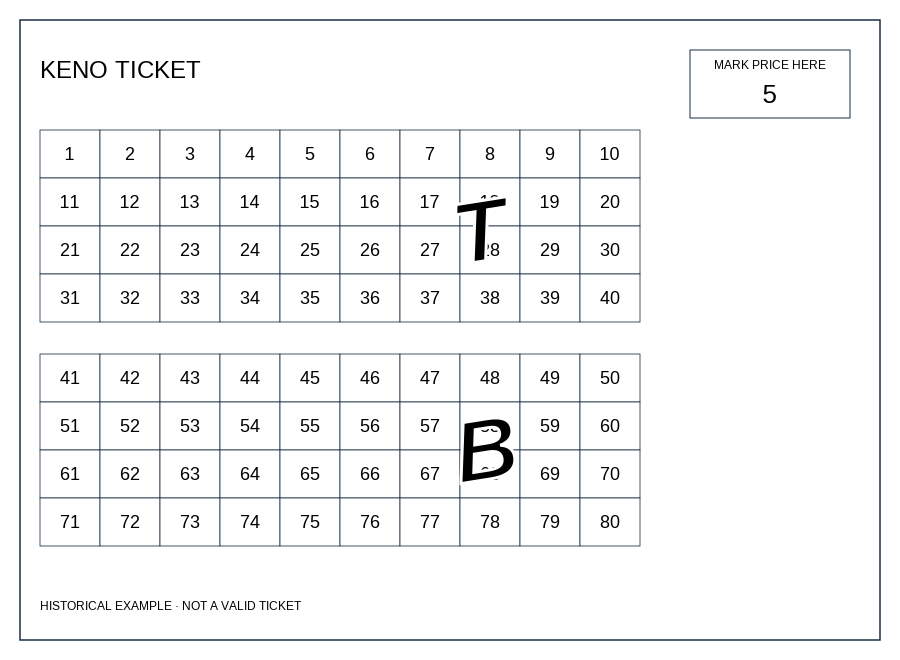
All you do is write “T” on the top half of the ticket and “B” on the bottom half.
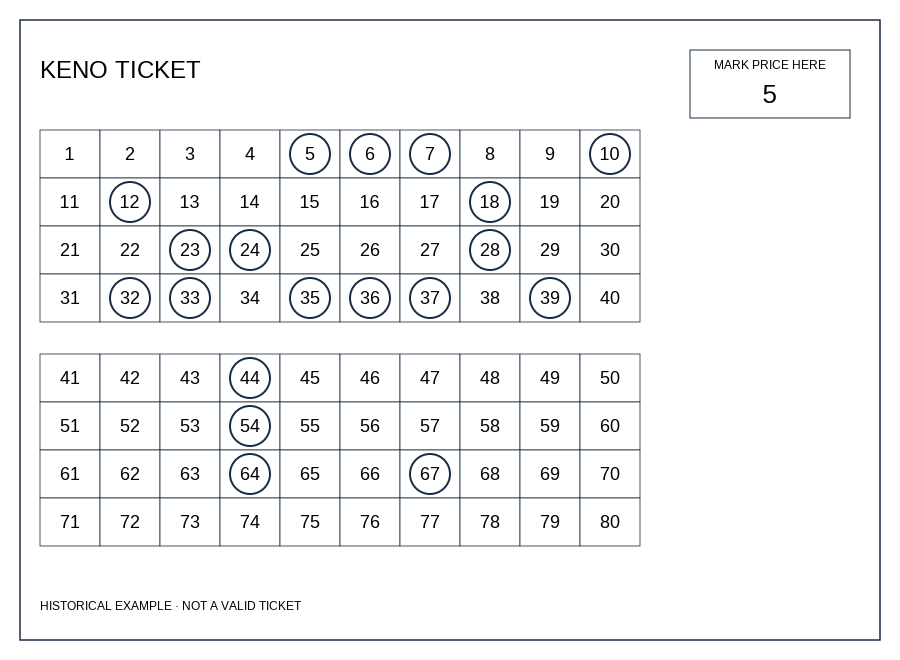
The first ticket we’ll show is the blank one, with the correct markings in order to play. The second ticket will show the amount of numbers caught. Each number called by the Keno operator will be circled, and then we’ll show a payout schedule and see what the payout will be.
Editorial note: The illustrated historical draw has nineteen circled numbers: fifteen in the top half and four in the bottom half. The source’s prose instead describes sixteen top-half catches and a $200 payout. The drawing is not a complete twenty-number draw, and no missing twentieth number has been invented.
Payout Schedule for the $5 Ticket
| Top caught | Bottom caught | Pays | Bottom caught | Top caught | Pays |
|---|---|---|---|---|---|
| 20 | 0 | $100,000.00 | 20 | 0 | $100,000.00 |
| 19 | 1 | $25,000.00 | 19 | 1 | $25,000.00 |
| 18 | 2 | $5,000.00 | 18 | 2 | $5,000.00 |
| 17 | 3 | $1,000.00 | 17 | 3 | $1,000.00 |
| 16 | 4 | $200.00 | 16 | 4 | $200.00 |
| 15 | 5 | $50.00 | 15 | 5 | $50.00 |
| 14 | 6 | $15.00 | 14 | 6 | $15.00 |
| 13 | 7 | $5.00 | 13 | 7 | $5.00 |
We pay on the ticket you hold each game.
This is the original ticket.
In the above example, there were 16 numbers called on the top part of the ticket. The payout would be $200 for the $5 ticket.
Choosing Between Top and Bottom or Left and Right
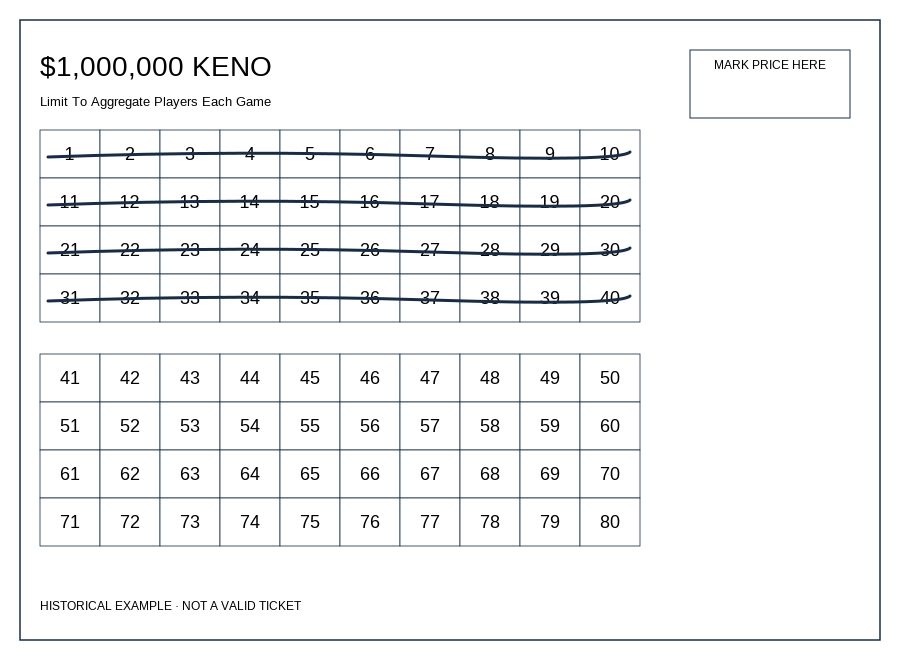
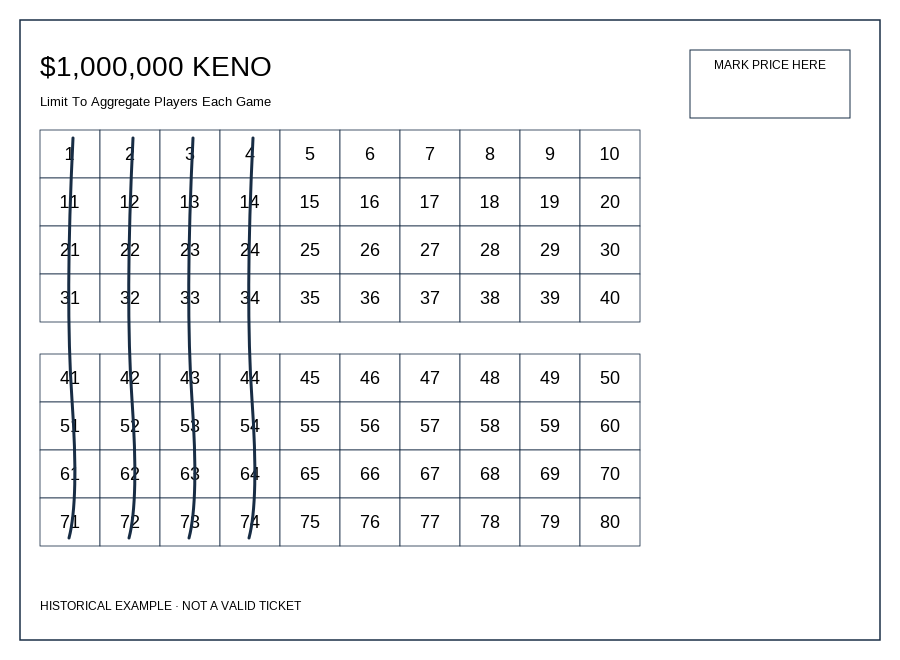
Some casinos not only have Top and Bottom betting but Left and Right side betting. The following shows how such a ticket may be marked and the possible payouts for a $5 investment.
Editorial note: The reproduced Left and Right illustration marks the first four columns, as supplied. Equal left and right halves of this ten-column grid would divide between columns five and six. The historical four-column strokes are retained and should not be used as a current marking instruction. The $1,000,000 masthead and aggregate-limit wording on these illustrations are source details, not the payout maximum for either table below.
Super Golden Touch Special: Alternative Payouts
$5 Super Golden Touch Special
Choose the:
Top and Bottom
or
Left and Right
Do not mark any numbers.
Payoffs are based on how many numbers are called on the Top-Bottom or Left-Right Combinations.
| Catch | Win |
|---|---|
| 0 + 20 or 20 + 0 | $100,000 |
| 1 + 19 or 19 + 1 | $50,000 |
| 2 + 18 or 18 + 2 | $5,000 |
| 3 + 17 or 17 + 3 | $1,500 |
| 4 + 16 or 16 + 4 | $150 |
| 5 + 15 or 15 + 5 | $50 |
| 6 + 14 or 14 + 6 | $10 |
| 7 + 13 or 13 + 7 | $5 |
| 8 + 12 or 12 + 8 | $0 |
| 9 + 11 or 11 + 9 | $0 |
| 10 + 10 or 10 + 10 | $0 |
Understanding the Top and Bottom Distribution
For a fair draw of twenty distinct numbers from eighty, the expected count in either forty-number half is ten. That is an average, not a requirement that each draw splits 10–10. The chance that either half contains at least thirteen drawn numbers is approximately 19.608%, or 1 in 5.10, under this model. This is a distribution probability for the illustrated thirteen-or-more threshold, not a profit probability or the chance of the top prize.
The calculation adds C(40, k) × C(40, 20 − k) ÷ C(80, 20) for k from 13 to 20, then doubles that sum for the two mutually exclusive qualifying halves. C(n, k) counts combinations. The same calculation applies to forty numbers on the left and forty on the right when the boundary is between columns five and six. The historical four-column marking is reproduced separately and is not an equal-half diagram.
A $5 return on the illustrated $5 ticket breaks even. A $200 total return would leave $195 after that ticket’s stake. These return calculations describe the supplied schedule only; neither verifies its current availability. The illustrated nineteen-circle draw remains incomplete and cannot independently demonstrate the prose’s sixteen-top-number result.
- Keno odds and draw-model assumptions
Read the related explanation.
- Return, net profit and overall odds definitions
Read the related explanation.